Showing posts with label book review. Show all posts

Monday, August 30, 2010

Book Review: "Overcompensating: A Dangerous Obsession" by Jeffrey Rowland

Overcompensating: A Dangerous Obsession

I'm a big fan of Jeffrey Rowland's surreal diary comic Overcompensating. It took me a while to read through the archives when I first started, but I thought it was worth it, especially since I think it's gotten better as it goes along. Like Achewood, I think Overcompensating has a wonderful way of using language - even if most of the time it's Weedmaster P calling someone a dick ass in a new and fun way. Rowland is able to write dialect in a way that still feels authentic - that's really difficult to do. But when you read the characters in Overcompensating, they sound like real people.

I also like the fact that his characters will be wearing shirts that change text randomly or they will all be wearing costumes, and no one will comment on this.

None of that is particularly relevant here, I just want to establish that I like Overcompensating a lot, and have high hopes for Mr. Rowland's future both with his comic and with the TopatoCo empire he has forged with his own robot arms.

Point being, when I heard he was making an Overcompensating book, I was very excited. Then I thought to myself, "why did this take so long? he has about 6 years of archives - he could have released a book years ago." Then I went back to being excited.

Thanks to David Malki, I got myself a copy of the book (THANKS DAVID MALKI!) and then proceeded to wait several weeks before writing a review, because I was lazy. But also because I realized the review was going to be very long. For example, we are several paragraphs in and I have still told you nothing about the Overcompensating Book except that it is a book.

Here's the deal with the book: I was disappointed. Some of this was the fact that this book, being Volume I, was full of the early comics - from the first (a classic example of forcing a bad punchline on a not-as-bad comic) to the one where Jeffrey moves from Oklahoma to Massachusetts. The fact is, they aren't great comics - yet. The later comics are better. It roughly corresponds to the quality of the art - which has a flat, far more cartoonish look to it at the beginning. It's also true that putting the comic into black and white takes away some of the energy and fun of the full color comics. I recognize that color printing would seriously increase the cost of the book, but it's also true that it would increase the quality of the final work. Would it be worth it? I don't know - I don't know what the costs would be.

But my real problem is this: The comics themselves are overrun with extra text. Here - I'll show you the image they have on the product description page:


See what I mean? Each comic (or almost all, at least) has a huge amount of text next to it, and I'd say a reader would have to spend about three or four times as much time on the text as on the comic itself.

Now, I realize that this is the exact opposite of the criticism I had for Kate Beaton's Never Learn Anything From History. In that case, I wrote that I was disappointed by how little she wrote about her comics. Nonetheless, I feel like I'm justified here - the problem with A Dangerous Obsession isn't so much the amount of text - though really, it's pretty crazy - it's that it's not all that interesting or relevant. It's mostly just random conspiracy theories of the sort that are occasionally funny in very small doses but are present here by the dozen. The stories just get boring after a while, and distract from the comic - especially when they are physically breaking up the comic itself, as in the left-most example in the image above. At some point I just wanted Rowland to leave his comics alone and let me read them, and not interrupt to tell me about the original version of Ghostbusters and how it was a documentary that made viewers go mad. I think a good example of the right balance to strike - both in tone and quantity - was the way Chris Onstad did it in the Achewood book.

All that said, the quality of Overcompensating: A Dangerous Obsession is made to look far better when compared with the atrocious introduction by one "Andrew W. K." The introduction actually goes for the middle school trick of "I don't know what to write about so I am going to write this introduction about writing this introduction." Mr. W. K. comes off as a huge tool here and in his other portrayals in the comic, and I hope to never have to deal with him again.

Also, just a caveat emptor sort of thing here: there is a picture of Rowland's horrible spider bite necrosis, and it is towards the beginning, and it is not as bad in black and white.

Final grade: C+. It pains me to write it, and I still love the comic - but for now, I'd say to stick with the online version. forgive me jeffrey.

Overcompensating: A Dangerous Obsession is 192 pages, softcover, black and white, and includes the story "Crisis on Infinite Butter Dimensions." It costs $14.

Wednesday, June 23, 2010

Book Review: "Never Learn Anything from History"

I wrote this about two months ago but wanted to wait a bit to post it. so: here it is.

http://www.spxpo.com/wp-content/uploads/2009/09/beaton.jpg
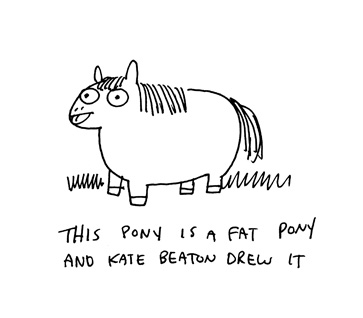
I dearly love Kate Beaton's History Comics (or, as the comic is now known, "Hark! A Vagrant") and was more than happy to help support her comicking. She has a way of making little sketches off-handedly which nevertheless amuse me (and I assume amuse others, since she tends to post them often). For example. In any case, the point is that I eagerly awaited her book being released.

Alas, I was disappointed. First, by the sheer brevity of it - only 68 pages, most with only one comic. There's absolutely no new drawings in the book, and most of the short notes after the comics are the same as the ones on the website (some adapted for the book format rather than a web format). There's no introduction (besides a two sentence "about this book" and a three sentence "about the author") and no real context for the book. There isn't even a title page or a copyright page - the whole thing has the feel of something thrown together as fast as possible.

That's not to say it looks haphazard; the comics are printed fine and there is no real problem with what is there, only with how much is not there. I think for her next book, Ms. Beaton should print at least twice as many comics as in this one, so it can feel more substantial. I'd also love to see more commentary - including more on the history. Most readers aren't going to have more than a passing familiarity - at best - with her subject matter. I certainly don't. Telling us more about some of these people and events would be nice. Some extra sketches would be great - perhaps practices for certain comics, or experiments with different ways of doing certain panels.

I strongly believe that a book of webcomics needs to give the reader something more than what they can get online - otherwise why buy it, besides supporting the author? [Achewood has been setting the bar on this count, incidentally] I'd like to think of this book as a subpar first draft from a comic that can do better, and I hope Kate Beaton and TopatoCo learn from Never Learn Anything from History.

Thursday, May 20, 2010

Book Review: "Problem Sleuth Volume 1: Compensation, Adequate"

http://www.mspaintadventures.com/scraps2/PSbookphoto.gif
I think it's safe to say that MSPaintAdventures has hurled itself to the top of the webcomic world faster than just about any other comic. 2 years ago Andrew Hussie had little more content than two frenetic, abandoned stories called "Bard Quest" and "Jailbreak." Taking their narrative developments from reader suggestions, the stories had little cohesion and were not that much fun to read.

But then he started writing a third story, Problem Sleuth, and he used a little more discretion in deciding which suggestions he would use to advance the plot. The story exploded into a year-long epic and MSPA has been going strong ever since. The plot follows a detective, Problem Sleuth (really his title but functionally his name) and his two compatriots, Ace Dick and Pickle Inspector, as they attempt to leave their office building. Jumping in and out of "reality," acquiring new weapons and skills, duplicating themselves, dying, going back and forward in time, and dealing with all sorts of Weird Puzzle Shit, the story is complex, to say the least. It takes the form of a text-based adventure game, with a command for a character at the bottom of each panel. Online, the reader clicks the command and the next page shows the consequence of that action, with a new command underneath that. Repeat 1700 times.

There are, of course, two ways to read the story online: In real time, a panel or two a day, stretched over a year, or all at once. The two are quite different, as I am realizing - I personally jumped on the MSPA bandwagon after PS was over, and I've been reading the current story, Homestuck, more or less in real time for the last year. PS, though, I went back and read all at once.

The main difference, I think, is that these stories are full of incredible detail. If you are reading a particularly long scene, for example, it may stretch over several weeks (remember that the final boss fight of PS is the entire second half of the story). If reading the story is something that you do a few minutes a day for months, you are liable to forget some of the details as large chunks of the rest of your life happen in between installments. Reading all at once, with only a few breaks, that's less likely to happen. Hundreds of panels ago may only be an hour or so back.

About a year ago, I spent a while looking around online for some site that had all of Problem Sleuth in one long, long page. I wanted to be able to load it all up and then read it over a long train ride, not knowing what else to do with that time. It occurred to me then - before I had read it - that a book might be the perfect format for this story. All the panels are about the same size, and you could just put a panel on each page. Yes, it would be a 1,700 page book, but it could be done. No? But then I started reading the thing, and I realized that putting it to the page would be a formidable task, not just for length reasons.

But PS's popularity remained strong enough that people decided a book would be a good idea, though not all in one installment as I had amusingly imagined. Volume I, "Compensation: Adequate" takes its name from the first chapter of the story and includes chapters 1-5 (there are a total of 22 chapters in the story). That gives you the introduction, where we get to know the world and the mechanics (as well as the main characters) and a few early boss fights. The book ends just as PS and AD reach some surly mobsters, just before the whole story does a high dive into the pool of crazy.

So how does the story work after it makes the jump from screen to page? For the most part, quite well. I'll talk about the positives first, since there are more of them. As I wrote above, this is a story that benefits from reading all at once. Say what you will about ebooks and reading online, I think most people will have a more pleasant time reading a long story on a printed page, all other factors aside. It's also faster to read this way, since you never have to scroll around for the next command to move ahead and wait for it to load. No internet connection is as fast as just looking a few inches over. In short, it feels less like a text-based game, the genre it is emulating, and more like a graphic novel. I think it does the story more justice this way and makes for a better read.

One thing I had just assumed they would do is print all the panels equally sized - as they are online. But I was wrong, luckily. As I said above, most pages have four panels, and that's good: the pace is kept brisk that way, since most of the panels are just barely advancing the plot. The panels that are important - the ones that deserve more emphasis in the rhythm of the storytelling - they get a full page. Like this one, or this one. Occasionally a large block of text means that a page only gets two or three panels, but it is always done intelligently. Like any good breaking up of rhythmic elements, the fact that you don't notice it means that it's been done well.

Unlike online, the chapters are noted in the text, with each one getting its own title page. I like this, and not only because the title pages have cool drawings that are a sort of more advanced take on an image from that section. Dividing them up explicitly gives the book a better sense of structure. You can feel closure at certain points, and know at others that a climactic moment is coming up.

Lastly, the book is printed nicely. The colors look good, the commands are in gray so they still feel different, and the panels are legible while still retaining the faux-MS Paint charm that the original had. In addition to the main text, there are a few pages extra Obnoxious Notes (a la this) in the back, and Ryan North wrote as fawning and toady a forward as we were all expecting (not a bad thing) (except, I usually love everything Ryan North does and quite frankly I didn't like this as much. I wonder if he really does love MSPA too much to write a good forward? think about this later).

Most pages (maybe 3/4) also have short notes by Andrew Hussie at the bottom about those panels. These I didn't like as much. Most felt unnecessary and pointless; the vast majority just make fun of the logical or artistic flaws in the story. Quite frankly, most of them felt forced into the book to give it some extra content. There are some interesting ones - a lot - that give insight into the story and the process of creating it, and I wish Hussie could have added more of these.

As an aside, a lot of the expository author's notes remind me of those from the Achewood book, in that they are the author, speaking seriously about the work we're reading. They are sort of the textual equivalent of a director's commentary on a DVD. They are interesting, but I can't help but think that there's something lost when the reading of a work is constantly being interrupted by the author telling you about it. You never get to experience the work, alone. On a DVD, of course, you just turn the commentary off, but you can't do that with a book, and skipping the comments altogether seems like a shame. Something to think about.

ALRIGHT, this review has gone on long enough already. Let's get to the serious problems and we can all go home.

As expected, a major loss in the book is the lack of animations. This is, of course, inevitable, but there are certain ways to get around it. The way Hussie chose was to either ignore the animation in some cases (where it was minor and not particularly interesting) but in the important ones, he splits up the frames and shows you all of them. So here's a comparison of one panel online and its print equivalent.


And how it looks in the book (with a little lens flare from my camera in the lower right corner):

Another one:


And how we see it now:

The fact that the notes below these sections always apologize profusely for the stacity of the image (i made that word up but it's good so whatever) only makes it more irritating to think that you are missing something. Luckily for now, the animations aren't too critical in chapters 1-5. But who knows what later chapters will need? I assume Hussie &co understand what they have to do and have a good plan.

One might wonder what the author could reasonably be expected to do, short of not produce a book at all. I think the best thing, though it would have been much more work, would have been to rework the story slightly and not hew so strongly to the original animations. Change the dancing, for example, to a new panel showing the same thing. If the art is created to be still, you can add details you wouldn't need if it was made to be animated. It would have made the story a little different from the one online, yes, and some purists (I assume there are MSPA purists) would have been annoyed. But the reader would benefit.

Other small notes: I was surprised that there were no page numbers. I was hoping for panel numbers, so that one can more easily cross reference the book with the online edition. Short of that though, I figured the pages would at least be numbered so you can remember where you left off (given that so many images are so similar). Not happening though. Also there are some typos and other small mistakes, that is unfortunate. I am sure the second edition can take care of these.

My final recommendation would have been to make one of the front pages a map of the Problem Sleuth world, like many fantasy books have. It could have been a nice place for some new art (not that there isn't plenty of new art spread throughout) but more importantly, it could have made a complex story far easier to follow.

(update: People point out that there is a map, thought it's not part of the story, but a more polished version of that is very close to what I meant)

IN SUMMARY,
"Problem Sleuth Volume I: Compensation, Adequate" is fun for the same reasons the online version of Problem Sleuth is fun. The story is good and told with humor, and the art adds to the strange tone of the whole thing. It's an easier story to follow on paper too, though some animated details are lost. There are those people who will love MSPA no matter what, and I don't think they will be disappointed by this. But the people who will be best served by this are those who tried to read the story online and didn't have the stamina for it. It goes faster and makes more sense in print. If you've been trying to get into MSPA, this is the easiest way to start. I look forward to seeing how the rest of the story works in book form.

Sunday, December 13, 2009

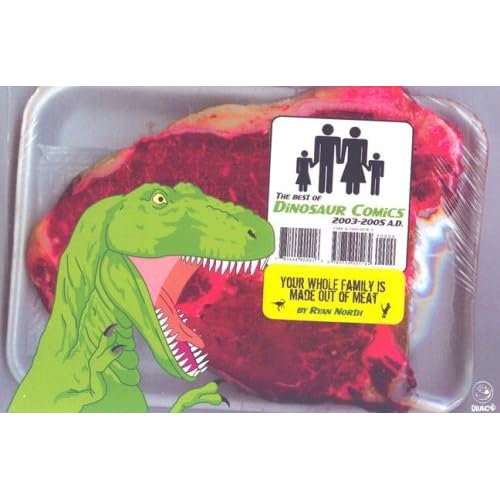
Book Review: "Your Whole Family Is Made Out Of Meat"

here is the picture of the dino comics book! you can't see it!
(link at TopatoCo is weird for some reason but I'm leaving it up)

It's no secret that I am a huge fan of Dinosaur Comics. So when a twist of fate forced me to buy a book online, I chose the only Dinosaur Comics book yet published, "Your Whole Family is Made Out of Meat: The Best of Dinosaur Comics 2003-2005 AD." Unfortunately, the book is little more than a printout of some of the comics online.

So what's in this book? First of all, the TopatoCo description claims that this book contains all the comics from 2003, when Dinosaur Comics started, through 2005. That's just completely false. I wish it did, but that would be something like 600 or 700 comics, and this book contains only about 250. The title even says it's "the best of" so really to suggest anything else is just dumb.

It has an introduction - a short, very short introduction - by Joey Comeau, and that's about it. Nothing from Ryan North besides a single line of dedication. A few strange photos from Found Magazine and precious little else is new in the book. Alt-texts are included under the comic, but only one - as you may know, Dinosaur Comics each have 3 alt texts. Hope you only enjoyed the rollover one, because that's all you are going to get in this book!

---------------------

Part of (perhaps most of?) the trick with books of webcomics is figuring out the balance between new and old material. Obviously, a good comic is successful because of its old content, that's what people know and what gained it its fame. But all its old content is (usually) still available online, so people need some additional reason to buy the book. The xkcd book solved this problem in a perfectly fine way; it had an substantial introduction, doodles and comments, and of course, those absurd puzzles (which are, of course, pretty great for the mind of your average xkcd fan). The Achewood book, created as it was by a man obsessed with writing about his characters, had commentary, and introduction, and dozen or so pages of text backstory. The Dinosaur Comics book...not so much.

----------------------

So the bulk of the book is the comics. And the comics are great, but you expected me to say that. I love them. Obviously. They're clever and sarcastic and energetic and thoughtful but that's all true online as well. Heck, at least online they are in color. Turning T-Rex and pals into black and white, as they are here, takes away something from the comic: It's lower energy, and seeing the same 6 shades-of-gray panels over and over gets monotonous faster than the color-filled ones online.

And there are ads in the back. What kind of book has ads in the back? And not cool ads, just lame ads for the publisher.

------------------------

Dinosaur Comics is one of the more popular comics online - one of the few able to be self-sustaining - and it's odd that its one attempt at publishing would be such a failure. I hope Mr. North and people he works with now can figure out what they did wrong (maybe by reading this post!) and try again - maybe the audience is big enough now that with a good approach, they could start over. Maybe release all the comics in yearly volumes? It would still be about 250-300 comics per book, but have a sense of completeness to it for obsessives like me. Dinosaur Comics is too great a thing to give up on.

Saturday, November 21, 2009

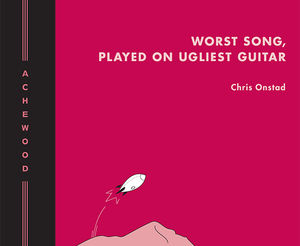
Book Review: "Worst Song, Played on Ugliest Guitar" - Achewood Volume II

buy it

Achewood is not like any other webcomic. There is something about it that makes most of its fans - myself included - completely obsessed with it, always trying to read as much as possible about its universe, and rereading the archives on a regular basis. If you ask us why, we will usually say something about characters.

Achewood's characters are unlike anything else in the world of webcomics. Not only does he revel in having them interact with each other, seeing just how their own personalities and speech patterns work with each other and in different situations. For example, when Lyle gives adorable five-year-old Phillipe his copy of The Anarchist's Cookbook, Phillipe does exactly the "right" thing for his character. You read it and you go yes! that is exactly what Phillipe would do!

Chris Onstad is basically obsessed with the world of Achewood. He freakin wrote blogs for all the characters for years. He managed 12 blogs. TWELVE. And they were filled with just more and more conversations between the characters. Here's a Thanksgiving one from a few years back. Here's another, non-thanksgiving one. He wrote a cookbook in the voice of all his characters, and when that wasn't enough, he wrote another one.

All of this is to say that when the second official Achewood book came out (but in many ways the first one doesn't count, so this new one is the first one) no one should be surprised that it is chock full of character stories.

The comics themselves are things we've all seen before - starting with the first comic and taking us up through this one - though not every comic from the period is included. Unlike the Great Outdoor Fight book, it does include alt-texts [as an aside, the alt-texts are included in small type underneath each comic, leading me again to wonder why the xkcd book needed to stick its alt texts in random places and at random angles between panels. Also, the title of each comic is included, something I thought xkcd should have done to help organization].

Note: color comics have been rendered in black and white. It isn't a big deal - there are only, by my count, six color comics in this period, and you can't notice that anything is missing if you don't know what it's supposed to look like - but when the titles are things like Color Monday! it does make it pretty obvious.

Most comics have comments below them, some of which are rather trivial but many of which are pretty interesting for Achewood obsessives like me (and, as I said in the beginning, nearly every Achewood fan is an Achewood obsessive). In addition, this map is reproduced on the title page, and these two are inside the front and back covers. They look damn classy there.

But of course, for those of us who have read all these early comics so many times, the real excitement is the new writing. There are no new comics, but there's a Prologue, featuring a regular day's conversation between Onstad, Ray, and Roast Beef, and there's "A History Of Achewood," explaining just how it is that Phillipe, Cornelius Bear, Téodor, and Lyle ended up living with Onstad. So committed to his world is Onstad, and so aware of this fact are his readers, that we don't think twice when the introduction is missing all the usual introductory stuff - "So here's how I started this comic, then I got famous, now I got a book, thanks for buying it" - but just goes head on into how these stuffed animals came into his life. And it feels right.

What's a little different - but by no means problematic - is that Onstad takes a much more active role in their stories than he usually does in the comic. We know that those characters live in his house, and he made occasional appearances in the early comics, but for the most part, he's faded away. Perhaps it is because these are early comics, but it doesn't feel wrong to have him take this role. In any case, what we all read for is the animals, and we get plenty of that (for example, here's Téodor: "I'm just trying to keep blood out of the food. It imparts an iron taste").

Lastly, a note on organization: The comics are not quite presented in order. Instead, it cuts the 8 month series in half, and reverses the two halves. This actually makes a great deal of sense. The very early comics are a bit random and strange, and take a while to get used to. There are no recurring stories, and the characters aren't really very consistent yet. In fact, Ray and Roast Beef aren't even around. It's fitting, then, that the book puts those first comics at the end (under the title "Before we were Achewood") and starts with the comic that introduced the cats. The "History" segment is also split up, starting at the beginning of the book, continuing between "Achewood" and "Pre-Achewood," and then putting the last installment at the end. It's a clever way to make the book feel like it has more content.

It takes a while for people to get into Achewood (it took me three tries before I realized how much I loved this comic), and many of them may have an easier time with both the print format and the fact that it starts out past all the strange early comics. And of course, Achewood fans will love the book, and will likely take a very long time to get tired of these comics, no matter how often you read them. But then again, Achewood fans already knew that.

Worst Song, Played on Ugliest Guitar: Achewood Volume II is 136 pages, hardcover, and $15.95. Note: xkcd: volume 0 was paperback and costs $18 ($35 for the signed copy!)

Thursday, October 15, 2009

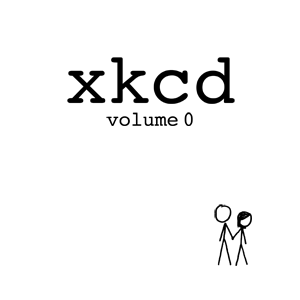
xkcd: volume 0 - The Review

woah hey, it's carl! i'm back to post this super special book review. then: aloria!
the cover is really boring, don't worry about it

First off, I want to start this by expressing deep and sincere thanks to Alexis Ohanian at Breadpig for sending me a copy of the xkcd book. The quick backstory is this: I wanted to do a review of the book; I didn't want to pay for it; I wanted free things. So on a whim I e-mailed Alexis (who, in addition to being a founder of reddit and breadpig, is the guy interviewing Randall in the Reddit Interview). He said yes, and I was excited, but also skeptical that it would actually work out (I mean, getting my mailing address is probably a good way to play a wonderful prank on me). So that's why I didn't mention it too much on the blog - I wanted it in my hands first. Doubleplus thanks to Alexis because not only did he send me a copy of the book, he sent me a second copy when I told him -truthfully, don't worry- that the first hadn't arrived.

My first feeling, after reading through the book, was genuine surprise. Not that it was particularly good or particularly bad - it isn't either. Just that the things that are bad are not the things I was expecting to be bad, and the things that are good are not the things I was expecting to like.

So let's talk about the details. The book is about 112 pages long (the page numbers, as discussed below, are mostly useless). Some larger comics (442, 556, 475) are split up on multiple pages; some pages get multiple smaller comics (page "10001," for example, has four one-panel comics - 179, 191, 210, and 200, in that order). Of course, some pages fit exactly one comic. This is just a necessary effect of how xkcd uses vastly differing sizes for its comics, but the result is a little jarring - the images and text on page, say, "page 111" are huge while the comics on "page 12000" have tiny little words and pictures. Stick figures that look about the same when you read xkcd on screen grow and shrink as you read on paper.

Yes, there are annotations and little drawings and stories included in the book, but not many. Perhaps 1/3 of the pages have them drawn in (in bright red). A few pissed me off (usually of the "if you don't get this joke, here is what it is referencing" or "lots of people love this comic" variety), but a few were interesting. Particularly those where he mentions that he made an error in the original comic and had to go back and change it - not something he usually admits. What I was not expecting was the codes. There are lots of different codes all over the place - series of letters, braille, dancing stick figures, numbers, puzzle poems, etc. The page numbers, which appear to be in ternary, are also apparently part of the code. While that might be fun for some readers, for most it will just make the book unpaginated for all intents and purposes. I personally don't care about the codes - to me, they are just annoying distractions that I won't be able to or care to solve. I guess I'll just look up the answers online sometime and see how clever they are.

That said, I am generally pleased with which comics Randall chose to put in the book. Only one of my "most hated" comics - 513 - made it to the book, but a few that I really like - 284, 285, 290, 487, to choose some at random - are there as well. Some choices are inexplicable - for example, Journal 1 and 2 are there [next to each other, unlike online] but none of the rest of that story. Why have the beginning but not the rest?

Now here is where we are going to get to one of the stranger aspects of the book, something I think is a fault, and I can't think of why they did this: Though Randall is careful to mention in the book's description that every comic's alt-text is included ("discreetly," though i don't see why that is necessary), neither the title nor the date of the comics are included. The Penny Arcade and A Softer World parodies aren't labeled as such, so if you don't know those comics, you are just going to be confused. And then there are some - ok actually we're going to do this differently.

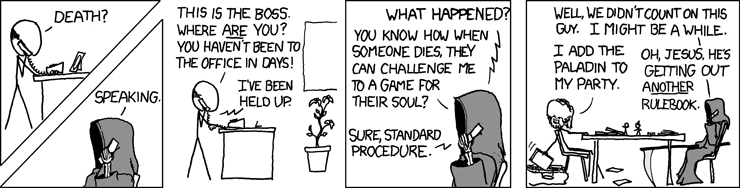
Read this comic. I've deliberately taken the title, date, and alt-text away. Now, if you happen to remember that key context, this next question isn't for you. But otherwise: did you think it was funny? Why? Just because it was a nerd playing a nerdy game?

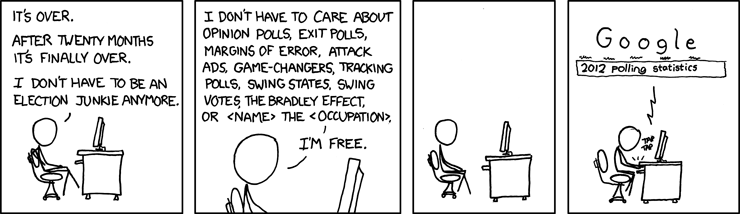
The point I'm getting at is that this comic came out right after Gary Gygax died, and that's him in the comic (the alt-text is "RIP, Gary"). But without that information - which is not present in the book - how is a reader supposed to know that? (The same problem exists, to a lesser extent, with comic 500. did you get it?) update: the alt-text for the Gygax comic is in fact included, as are all the alt-texts. But even with that, the context is still hard to get.

That is enough criticism for now, I think. The book is nicely printed, with the few comics that are in color looking pretty good. The "copyright" page is nice, though the introduction won't tell you much new beyond the "How I got Started Writing XKCD" stuff. And I do really like the back cover.

In short, it's a book that an xkcd fan - or even someone who used to be a fan - will like, but if you are expecting much more than what you can find online, you'll be disappointed.

(update: Hey, look which book review is on twitter. if you said "this one" well yeah, that was obvious)
============

update: OH, and today's panel 5 utahraptor? I totally get your secret hidden reference. totally! but thank you for not using your obscure reference as a punchline, only as a throwaway line that people can ignore with no problems. thank you utahraptor, for all that you do.